
KOSOVAN — Financial Technology Expert

Financial Expertise

Financial expertise for the upgrade of your IT business.

Accounting systems, cash-flow architecture, metrics, payroll and international presence for fast-growing technology companies. KOSOVAN helps founders and management teams move from fragmented finance processes to a structured, automated and decision-ready financial system.

Five stages of finance evolution

From the foundation of a business, corporate finance passes through five stages.

Every company starts with manual control. As the business grows, finance needs to evolve: through tools, automation, analytics and, eventually, predictive financial systems. For IT companies, this journey is often compressed — growth happens quickly while the financial system stays behind.

  1. 1

    Manual Stage

    The founder controls payments, planning and analysis personally. Reporting is situational and there is no delegation.

  2. 2

    Tools Stage

    The company starts using systems that collect data. Accounting is delegated, but finance costs grow together with the team.

  3. 3

    Automation and Digitalisation

    Accounting systems exist, but policies and processes are not yet fully documented. Automation releases resources but can also absorb them.

    CFO required
  4. 4

    Analytics / Big Data

    A mature finance function with quality accounting, automation, budgeting and data analysis. The company can prepare for international audit.

  5. 5

    Predictive Finance & Financial AI

    The business works with forecasts, scenarios and long-term financial models. Finance becomes agile and forward-looking.

The bottleneck

Most companies get stuck at stage three: automation and digitalisation.

At first, automation looks simple. It may feel as if everything is running by itself. In reality, this stage requires constant control. Someone has to sit down, describe the processes, document how they work and decide exactly what should be automated.

Without proper management, automation can become endless. After some time, no one remembers where the process started, why certain decisions were made, or how the system is supposed to work.

Automation without documented financial logic becomes permanent automation.

Why the founder needs a CFO from stage three

In IT, there is no luxury of slow learning.

In traditional industries that grow slowly, a company may have five to ten years to find, train and develop a finance leader internally. In IT, fast growth does not leave much time for trial and error.

The company needs to manage automation, write policies, establish controls and prepare operational finance specialists quickly. The role of KOSOVAN is to provide external CFO-level expertise and help upgrade the finance function of the business.

Growth vs. finance maturity

Business growthFinance maturity
The gap

Business growth in IT typically outpaces the maturity of the finance function — exactly the gap that CFO-level work is designed to close.

Beyond the bottleneck

Passing the third stage is not the final goal. It is the route to the higher levels of the game.

A well-managed finance upgrade creates the foundation for analytics, predictive finance, financial AI and strategic investment decisions. The goal is not only an efficient finance department — it is a financial system that supports scale, resilience and long-term strategic choices.

6

External investment

The company begins to use financial and investment instruments to generate returns. The finance function does not only support the core business — it can also create additional cash flow.

7

Financing cultural expansion

The company operates within ecosystems and develops projects and strategies aimed at long-term social value — philanthropy, patronage, charitable foundations and legacy planning.

Seven stages of finance evolution

From inward control to outward impact.

The finance function evolves together with the founder, the business model and the company’s strategic horizon. Attention shifts from inward — control, accounting, automation, analytics — to outward — investment, ecosystems and long-term social value.

Attention inwardAttention outward
  1. Stage 1

    Manual

    The founder controls finance directly. Personal money and company money may not yet be clearly separated.

  2. Stage 2

    Tools

    A more formal approach to money movement between founder and company appears. Accounting records flows clearly.

  3. Stage 3Pivot

    Automation

    Founder money is separated from company money. Risks are separated. A CFO appears. The financial code of the company must be documented.

    The financial code of the company must be documented.

  4. Stage 4

    Analytics

    Accumulated data becomes real indicators for timely decisions. The business starts to speak the language of numbers.

    Entry to the “big circle”.

  5. Stage 5

    Predictive Finance

    Long-term strategy and risks are built into the model. Scenarios are calculated and risks managed or hedged.

  6. Stage 6

    External Investment

    The company generates cash flow through financial and investment instruments, independently from core operations.

  7. Stage 7

    Cultural Expansion

    The company chooses strategies and projects based on long-term social value: philanthropy, patronage and legacy.

Evolution pyramid

Five stages of corporate finance evolution.

Passing through every stage of evolution is a challenge that every founder eventually faces. The pyramid maps that journey from manual control at the base to predictive finance at the apex.

Stage 5Predictive Finance & Financial AI
Stage 4Analytics / Big Data
Stage 3Automation and Digitalisation
Stage 2Tools Stage
Stage 1Manual Stage

Stage 1Manual Stage

The founder controls payments, planning and analysis personally. Reporting is situational and there is no delegation.

Stage 2Tools Stage

The company starts using systems that collect data. Accounting is delegated, but finance costs grow together with the team.

Stage 3Automation and Digitalisation

Accounting systems exist, but policies and processes are not yet fully documented. Automation releases resources but can also absorb them.

Stage 4Analytics / Big Data

A mature finance function with quality accounting, automation, budgeting and data analysis. The company can prepare for international audit.

Stage 5Predictive Finance & Financial AI

The business works with forecasts, scenarios and long-term financial models. Finance becomes agile and forward-looking.

Comprehensive upgrade or individual tools

Whole-architecture finance transformation — or targeted work where it matters most.

Every IT business is at a different stage. Some companies need full transformation; others need targeted improvements in a specific area: accounting, cash-flow architecture, payroll, metrics, valuation or international presence.

Hub

Comprehensive upgrade

Whole-architecture finance transformation, when the business is ready to move beyond fragmented systems and into scalable, decision-ready financial infrastructure.

  • Accounting & reporting systems
  • Metrics & OKRs
  • Company valuation logic
  • Cash-flow architecture
  • Payroll
  • International presence

Accounting & reporting systems

Suitable accounting or ERP software depending on the complexity of the organisation, from cloud accounting to full ERP platforms such as Odoo.

Metrics & OKRs

The numbers that answer critical management questions: is growth proportionate to costs, is the project burning cash, what is its real value.

Company valuation logic

A consistent approach to understanding what the business is worth — for management decisions, investors and structured growth.

Cash-flow architecture

A clear scheme for how money moves through the business, with treasury, banking and reconciliation logic that scales with growth.

Payroll

Financial, legal and structural design for distributed teams, contractors and international compensation arrangements.

International presence

Practical guidance on where to register, how to structure cross-border flows and how to align with customer, investor and banking realities.

How many levels of upgrade are there?

Five upgrade levels — each unlocks the next.

From delegation and accounting systems, through automation and analytics, to predictive systems. Most companies stop at level three. Only those that complete the homework on processes, policies and data earn the right to dashboards and predictive finance.

  1. 01

    Delegation

    The founder hires an assistant and gives access to financial information and payment processes. Control is no longer fully centralised, and the founder gets back the most valuable resource: time.

  2. 02

    Accounting system

    An accounting system, such as 1C or an equivalent platform, becomes the data core. The company has an informal policy for collecting financial information.

  3. 03

    Automation

    Endless process automation begins. This is where most companies stop. Without documented financial logic, automation becomes permanent automation.

  4. 04

    Analytics

    Analytical systems and BI tools appear. Only companies that have done the internal homework on processes and data quality reach this point.

  5. 05

    Predictive systems

    Predictive finance is the technology of working with what has not happened yet. By this stage, the company has strong software and strong operational financial thinking.

Valeriy Kosovan — Financial Technology Expert

Founder

Hello, I’m Valeriy Kosovan, founder of KOSOVAN FTE.

I personally passed through the finance upgrade stages described here as CFO of a fast-growing technology business — building the function from the ground up across multiple jurisdictions.

  • Built the financial planning and budgeting process from zero.
  • Developed a financial planning system that forecasted operating cash flow with an annual deviation of approximately 7%.
  • Registered companies and built tax-accounting systems across ten jurisdictions including the USA, the United Kingdom, Ireland, Cyprus, China, Georgia, Bulgaria, Estonia, Czechia and Ukraine.

Over eight years I built a successful and efficient finance department for a company operating at the fifth level. The main idea is simple: finance in IT has its own specific character — and the cost of learning it the slow way is too high.

What works

Experience multiplied by drive.

Practice shows that the formula for fast change comes down to two mutually reinforcing factors. Experience — the expertise of someone who has already passed through the stages of growth. Drive — the internal energy of the business and its team.

Experience

Hands-on CFO and transformation practice

×

Drive

The energy of the business and team

=

Fast transformation

A finance system ready for the next stage

This formula became the foundation of our product.

Service areas

Accounting, payroll, metrics and international presence.

The four operating areas where finance work consistently creates measurable improvements for IT businesses.

Accounting

The result of a well-built accounting system is transparency and convenience. We help implement cloud accounting for simpler structures and ERP platforms such as Odoo for complex international organisations.

  • Transparency
  • Scalable reporting
  • Audit readiness

Payroll

IT is a people-intensive business. We help address the financial, legal and structural questions that arise when working with distributed teams, contractors and international arrangements.

  • Distributed teams
  • Tax efficiency
  • Operational clarity

Metrics

Metrics give investors and managers answers to critical questions: is growth proportionate to cost, is a cash-burning project actually growing, what is the real value of the project.

  • Growth quality
  • Cash-burn quality
  • Project valuation

International presence

IT businesses often choose international jurisdictions for security, customer proximity and investment. We help decide where the company should be based, taking into account team plans, customer traffic, investor expectations and banking realities.

  • USA
  • United Kingdom
  • Ireland
  • Cyprus
  • Georgia
  • China
  • Bulgaria
  • Estonia
  • Czechia
  • Ukraine

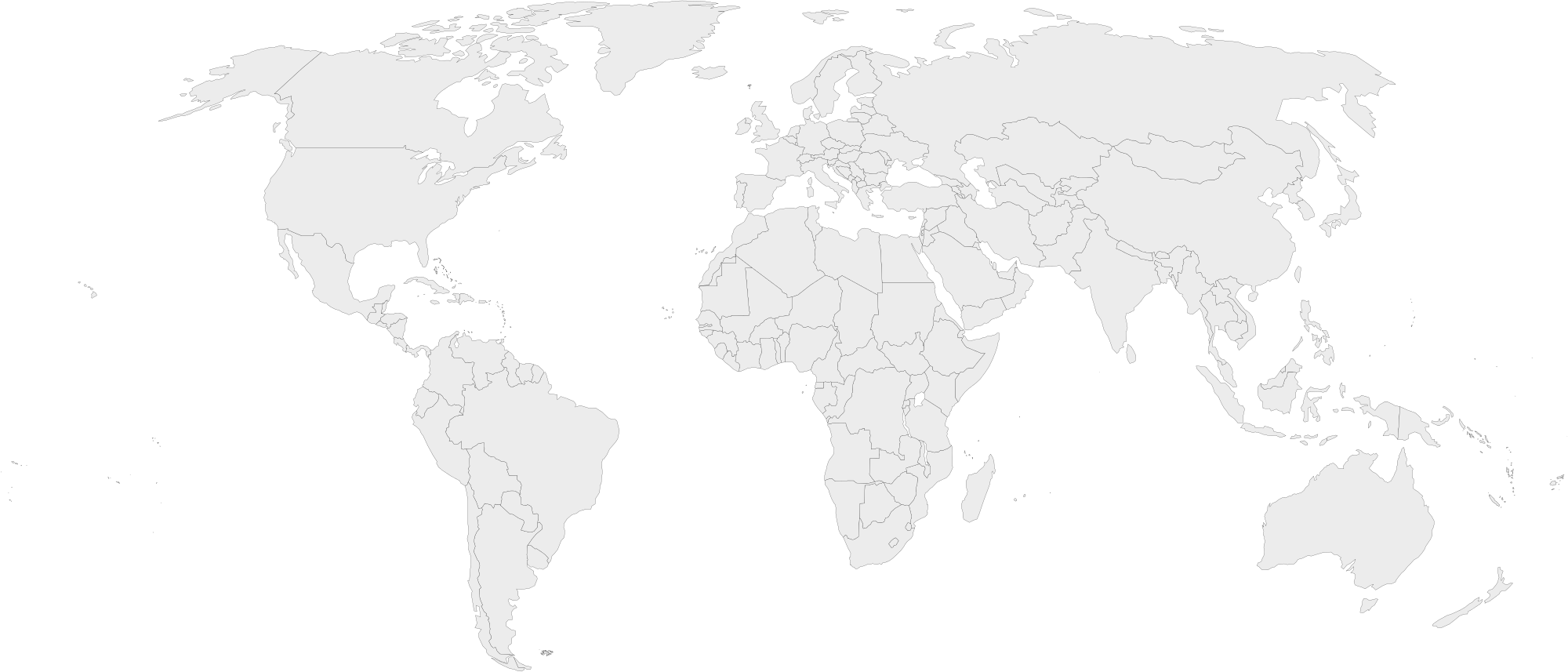
International presence

Where finance work actually crosses borders.

Practical experience across ten jurisdictions for security, customer proximity and access to investment. The deeper challenge is not registration — it is banking, substance, residency and operational reality.

  • US

    United States

  • IE

    Ireland

  • UK

    United Kingdom

  • CZ

    Czechia

  • EE

    Estonia

  • UA

    Ukraine

  • BG

    Bulgaria

  • CY

    Cyprus

  • GE

    Georgia

  • CN

    China

Get in touch

Build finance infrastructure that can scale.

If your business has outgrown spreadsheets, fragmented reporting or informal financial processes, it may be time to upgrade the finance function. I help founders and leadership teams design the systems, structures and reporting discipline needed for the next stage of growth.